
The Estate Planning Checkup: Vital Signs Your Plan May Be Out of Date

By Jon G. Sanchez, CEO - Specialized Trusts & Estate Plans
You go to the doctor for a checkup. You get your teeth cleaned. You service the car before a long trip.
But an estate plan? Most people sign it, put the binder on a shelf, and never look at it again.
Then life keeps going. New bank accounts. A refinance. A move. Kids grow up. Grandkids show up. Maybe a business gets sold. The plan stays right where it was.
Years later, the family opens that binder expecting it to work.
A lot of the time, it doesn't. Not because nobody cared. Because nobody checked.
Your Estate Plan Is Not a "Set It and Forget It" Document
I see this constantly.
Someone spends the time and money to get a plan in place. Then they open accounts, buy property, change relationships, and never update the trust. When that plan is finally needed, the documents are old, the people named may no longer be the right people, and the assets may not even be sitting where the trust assumes they are.
An estate plan only works if it still matches your life. That means the people you chose, the instructions you left, and the way your assets are actually titled today.
Skip the checkup, and those gaps usually stay quiet until incapacity or death. That's the worst time to find them.
Two Questions Every Checkup Should Answer

If you only remember two things from this post, make it these:
- Does my plan still reflect what I want today?
- Will my assets actually follow that plan if I become incapacitated or die?
A plan can look great on paper and still fail both questions.
What's Usually Inside the Binder
People ask all the time what's in an estate plan. Strip away the legal noise and it's usually four core documents:
- A revocable living trust (your main set of instructions)
- A pour-over will (the backup that can push leftover assets into the trust)
- A financial power of attorney (who handles money if you can't)
- A healthcare directive / advance directive (who speaks for you medically)
Having those documents is step one. Making sure they still work together is the checkup.
Estate Plan Vital Signs
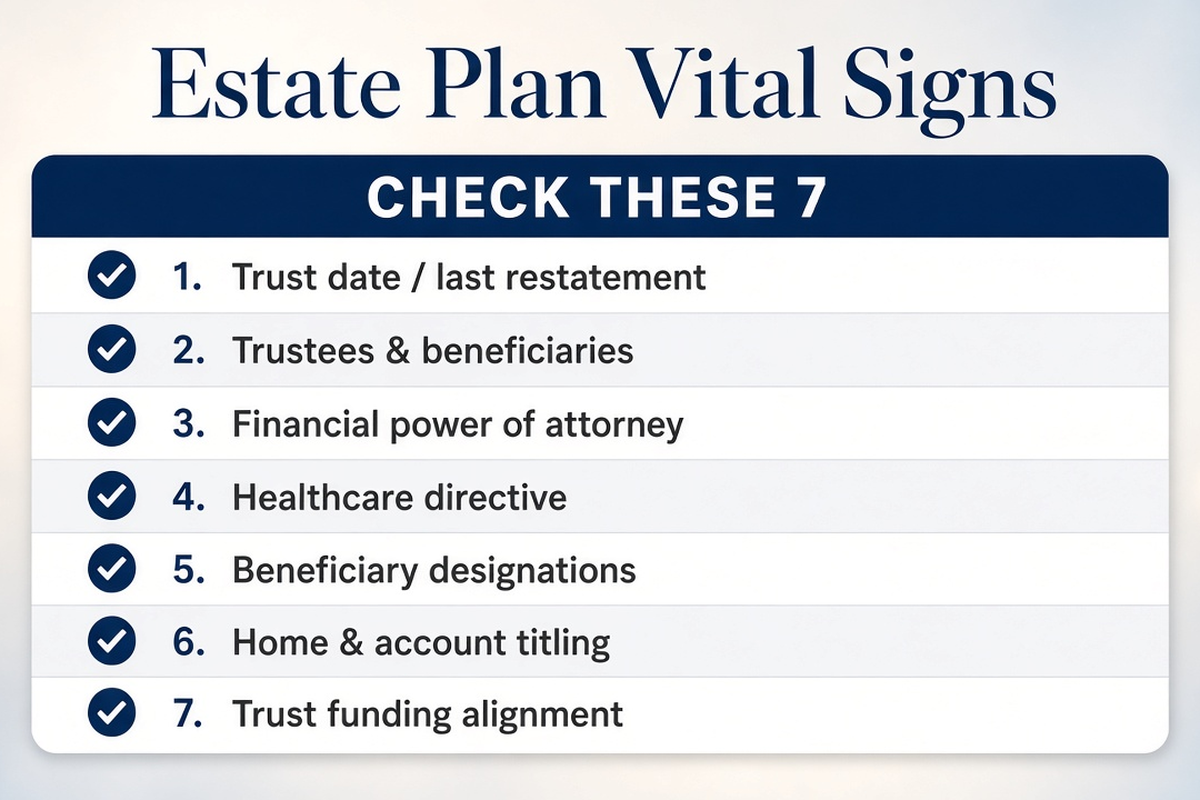
When you go to the doctor, they check your vitals. Your estate plan has vitals too. Any one of these can tell you it's time for a closer look.
1. Is the plan current?
When was the trust signed? When was it last restated or updated?
If it's been years, the plan might still be "valid" and still be wrong for your life now. Restatement is just a cleaner way of saying the trust got rewritten to match what's true today. At S.T.E.P.TM, a huge share of what we do is restatements for exactly this reason.
2. Are the right people still named?
Look at your successor trustees, financial agents, healthcare agents, and beneficiaries.
The person who made sense ten years ago may have moved, passed away, gotten divorced out of the family picture, or simply stopped being the person you'd trust with this. Kids who were minors then may be adults now. That changes the conversation.
3. Is your financial power of attorney still set up the way you want?
This is the person who can manage finances if you can't.
Some powers of attorney are durable, meaning they can be effective once signed. Others are springing, meaning something has to happen first (often a medical determination that you can no longer handle your own decisions). Different families want different setups. The checkup question is pretty simple: if you couldn't act tomorrow, is the right person clearly authorized?
4. Is your healthcare directive still accurate?
Who can make medical decisions for you? Are they still the people you'd choose? Do the instructions still sound like you?
5. Do your beneficiary designations still match the plan?
This one catches people off guard.
IRAs, 401(k)s, life insurance, annuities, and a lot of POD/TOD accounts don't automatically follow the trust. They follow the beneficiary form on file. If that form is outdated, it can override what the trust says.
6. Are your home and major accounts titled the way you think?
The trust can list an asset all day long. If the deed or account registration never got updated, ownership records still run the show.
7. Was the trust funded, and has anyone checked funding since?
Funding means moving eligible assets into the trust so they can avoid probate. Homes, taxable bank accounts, brokerage accounts, that kind of thing.
Most people do some of this when the plan is signed. Then they open new accounts later and never loop them in. That's how families end up in probate with a trust sitting on the shelf.
What It Looks Like When One Vital Sign Is Off
Picture this.
You have a living trust. You signed everything. You figured probate was handled.
But the house never got retitled. Or an old IRA still names an ex-spouse. Or the successor trustee from a decade ago is no longer someone you'd pick.
The binder looks finished. The outcome for your family may not be.
A Quick Checkup You Can Do at Home

You don't need to rebuild the whole plan tonight. Start with a short pass:
- Find the date on the trust (usually near the front)
- See who you named as successor trustee
- Check your financial and healthcare agents
- Look at beneficiary designations on retirement, insurance, and annuity accounts
- Review how the home and major accounts are titled
- Write down what has changed since the plan was created
If any of that makes you unsure, good. Uncertainty is useful here. It means you're catching the issue while you can still fix it.
When a Review Is Especially Worth Doing
Don't wait for a crisis if any of these have happened:
- Marriage, divorce, birth, or death in the family
- Kids who are now adults
- New grandchildren
- Buying or selling a home or business
- Opening new accounts after the trust was signed
- A move to another state
- A trustee, agent, or beneficiary who no longer belongs in the plan
- That nagging feeling that something in the old plan just isn't right
That last one comes up more than you'd think. People will sit down with us and say, "I feel like something's off." They're usually right to ask.
What S.T.E.P.TM Looks at in a Review
At Specialized Trusts & Estate Plans, we care less about whether the paperwork looks complete and more about whether it would actually work.
Through the Trust Review & Optimization Plan, we help you check:
- Whether the plan still reflects what you want
- Whether the named people still make sense
- Whether the supporting documents still line up
- Whether beneficiary designations and account titles match the plan
- Whether funding gaps could still push assets into probate
- What to do next, whether that's a targeted update or a full restatement
The point isn't to create more documents for the shelf. It's to make sure the plan you already have (or the one you need) can do its job.
Bottom Line
A binder is not a working plan.
Your family shouldn't be the ones who find out the hard way that the people, the instructions, or the assets don't line up anymore.
A checkup now beats a surprise later.
Ready to Take the Next Step?
If you're not sure your estate plan would still do what you signed it to do, let's find out while you still have options.
Start the Trust Review & Optimization Plan and get a clear read on where things stand today.
FAQ
How often should I review my estate plan?
After any big life, family, or asset change. Even without a big event, if it's been years since anyone opened the binder, it's worth a checkup.
What is a trust restatement?
A restatement updates an existing revocable living trust so the current terms, people, and instructions match your life now. In a lot of cases, that's cleaner than stacking amendment after amendment onto an old document.
Does having a trust automatically avoid probate?
No. The trust helps when assets are positioned correctly through funding, titling, and coordinated beneficiary designations. A signed trust with unfunded assets can still leave a family in probate.
What's the difference between a durable and springing power of attorney?
A durable power of attorney is usually effective when signed. A springing power of attorney usually waits for a triggering event, like a determination that you can no longer manage your own decisions. The exact language and your state's rules matter, so this is worth reviewing carefully.
What should I bring to an estate plan checkup?
Your trust and supporting documents, a rough list of major assets and accounts, beneficiary designation info if you have it, and notes on what has changed since the plan was created.